
Let’s start with something weird: what if the LEDs above your desk are doing more than just lighting up your workspace? Here’s a story—not about sunburnt beachgoers, but about super-fit astronauts who came back from space looking decades older than when they left. That’s not science fiction; it’s a real puzzle for mitochondrial researchers. And it might actually matter to you—even if you never leave Earth’s gravity. Buckle up for a wild ride through blue light’s impact on our energy, aging, and everyday life. Plus, a confession: at first, even the experts didn’t see this one coming.
Astronauts, Space Stations, and the Curious Case of the Aging Mitochondria
In a high-profile NASA study published in Cell, researchers uncovered a startling trend among astronauts aboard the International Space Station (ISS): even the fittest crew members began showing signs of pre-diabetes and accelerated aging. The culprit? Impaired mitochondrial function, likely triggered by constant blue light exposure from the ISS’s white LED lighting, which peaks sharply at 420–450nm.
One astronaut’s before-and-after photographs became a talking point among aging experts—her appearance after a year in space showed dramatic aging compared to her brief pre-mission stay. NASA’s findings revealed that as mitochondria slowed down, astronauts’ blood glucose levels rose, making these super-fit individuals suddenly ‘older’ and less metabolically healthy. As one observer noted,
“Something else happened which a few aging people may have predicted. I didn’t predict it at all. They’re starting to age faster.”
This case highlights how environmental factors—especially blue-rich LED lighting—can disrupt mitochondrial function and accelerate aging effects. With mitochondria regulating the pace of aging, these findings raise urgent questions for the future of long-duration space travel and our own blue-lit environments on Earth.
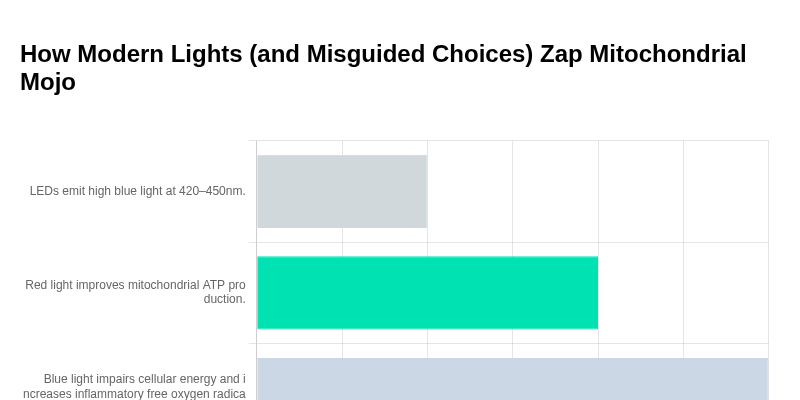
How Modern Lights (and Misguided Choices) Zap Mitochondrial Mojo
Red and blue light have opposite effects on our cells: red light boosts, while blue light undermines mitochondrial function. The main culprit? Modern LED lighting. Today’s homes and offices are flooded with blue wavelengths, especially in the 420–450nm range, thanks to the sharp blue spike in most LEDs. This is a big shift from the natural balance of red and blue light found outdoors or in traditional incandescent bulbs.
Why does this matter for mitochondrial health? Mitochondria absorb blue light at 420nm, which quickly disrupts ATP production—the process that fuels cellular energy. As one expert put it,
“Red light improves mitochondrial performance; blue light undermines it.”
This disruption doesn’t just stay local. Mitochondria operate as a community, meaning that even limited blue light exposure can send stress signals throughout the body’s entire ‘mito-community’.
While blue light doesn’t penetrate deeply, its effects are widespread due to inter-mitochondrial communication. Chronic blue light exposure from daily life under LEDs may subtly erode metabolic health over time, increasing cellular stress and reducing energy production. The shift to blue-heavy LED lighting is an unintended experiment with our cellular energy systems.
From Mouse Mazes to Organ Size: Surprising Animal Experiments
In a striking study on mitochondrial dysfunction and the blue light hazard, researchers exposed mice to intense blue LED light (420–450nm) for about five hours daily—similar to what many humans experience in office environments. The results were alarming. Not only did the mice gain significant weight, but fat accumulated in unexpected places, hinting at disrupted energy metabolism and altered mitochondrial pathways.
Even more surprising, key organs like the liver, heart, and kidneys actually shrank and showed clear signs of pathology. As one researcher noted,
“The tissue is pathological. These are middle-aged mice—they shouldn’t be like that.”
Blood tests revealed high ALT levels, a marker for liver aging and disease. Behavioral tests showed the mice became more stressed and avoided open spaces, suggesting systemic mitochondrial malaise.
These findings point to a systemic impact: blue light exposure doesn’t just affect the eyes or skin, but can trigger widespread aging effects and organ dysfunction. The culprit? Disrupted mitochondrial function and increased Reactive Oxygen Species (ROS), which damage tissues even in organs shielded from direct light. This research raises urgent questions about the hidden risks of our everyday blue-lit environments.
LEDs, Invisible Hazards, and the Real Cost of a Brighter Home
Walk into any modern home, office, or public space, and you’re likely surrounded by LED lighting. While these bulbs are energy-efficient, their hidden blue light hazard is rarely discussed. Most people don’t realize that swapping out bulbs could impact their long-term mitochondrial health and energy metabolism—sometimes even more than tweaking their diets. LEDs emit a strong blue spike, which disrupts how mitochondria power our cells. In contrast, old incandescent bulbs offer a gentler, red-rich light that supports cellular energy.
“I was always running around saying to people, change your light bulbs because you want more red light in them. So get an old incandescent light bulb.”
This personal crusade often meets disbelief, but the science is clear: our ‘light diet’ matters. The invisible influences don’t stop at lighting. Everyday exposure to Wi-Fi, 5G, and Bluetooth, along with low magnesium intake, quietly chips away at our health. As LED lamps dominate lighting design, the public health conversation must expand. The real cost of a brighter home may be hidden in plain sight—impacting our mitochondria, metabolism, and overall wellbeing. Caring for your cells could be as simple as reconsidering the light above your head.
Curiouser and Curiouser: Unresolved Mysteries and Speculative Science
Blue Light Exposure is raising more questions than answers, especially when it comes to Mitochondrial Function and aging. Can a ketogenic diet shield our cells from blue light’s effects? The truth is, no one knows for sure. As one researcher puts it,
“There are so many big questions we don’t know—I don’t know the answers to that and I’d love to.”
Animal studies, from Aging Flies in custom ‘fly hotels’ to mice under intense lamps, are revealing that blue light may disrupt Mitochondrial Pathways, but the exact risks for humans remain unclear. Mouse studies use blue light levels much higher than a typical LED desk lamp, yet office workers may face 12–14 hours of chronic exposure daily—possibly a slow-motion public health crisis hiding in plain sight.
Ongoing fly incubator experiments are helping to fill these knowledge gaps, but there’s no definitive ‘cure’ yet. As research evolves, it’s wise to stay curious and proactive. Could your daily environment be affecting your mitochondrial health? Now is the time to schedule a health assessment and see how your choices—and your lighting—might be shaping your future well-being.
TL;DR: Blue light—the kind pouring from most LEDs—does more than mess with your sleep. It disrupts mitochondrial function, accelerates aging, and could wreak havoc on your metabolic health. If you care about long-term wellness, consider swapping out your light bulbs and schedule a consult to tailor your lighting (and lifestyle) for optimal mitochondrial health.
